
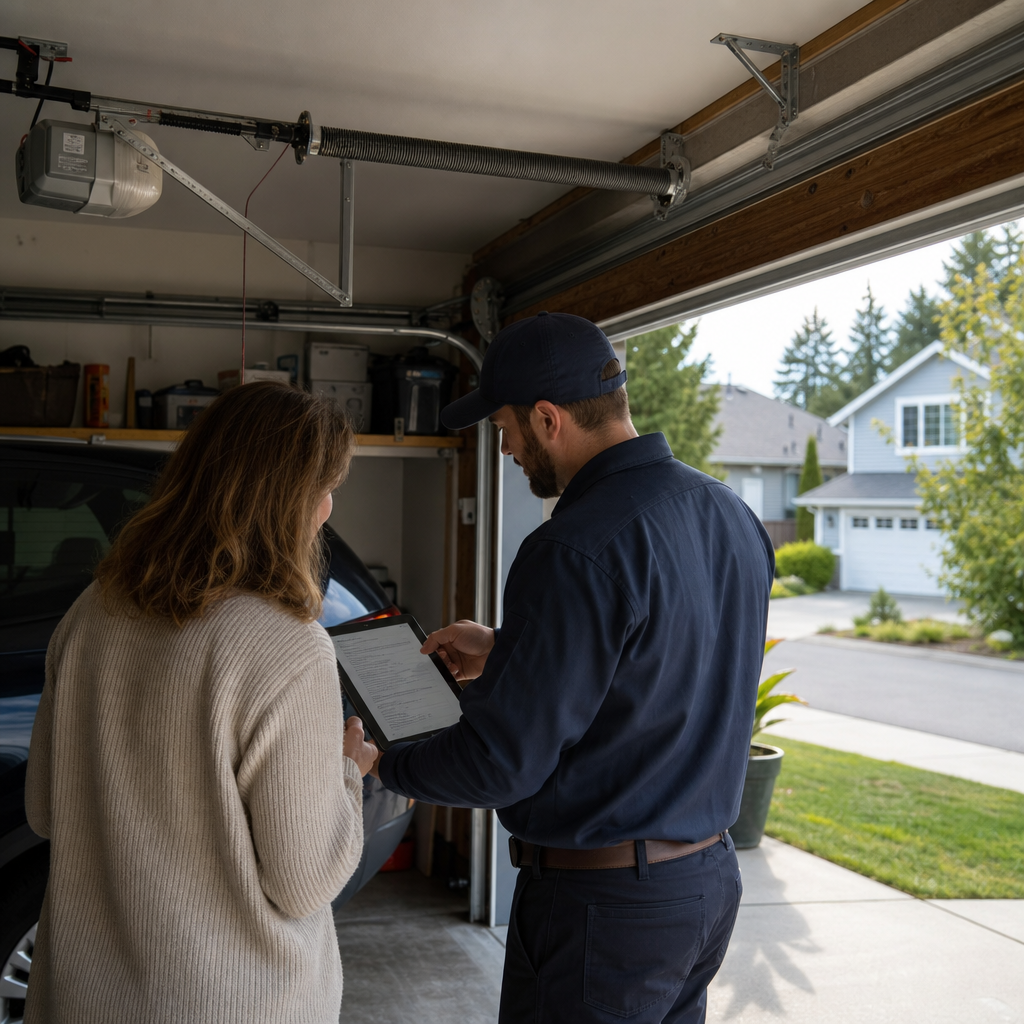
Garage Door Opener Installation in Washington, WA: What You’re Actually Paying For
Garage door opener installation in Washington typically runs $295–$650 and is usually completed in 2–4 hours when the existing door system is properly matched to the new unit. At Matrix Garage Door Repair Washington, we install and configure openers as integrated systems — not standalone motor swaps — because a new LiftMaster on a door with the wrong spring tension isn’t a smart home upgrade, it’s a motor working harder than it should every single cycle. Call (844) 749-2402 for a free estimate and same-day scheduling.
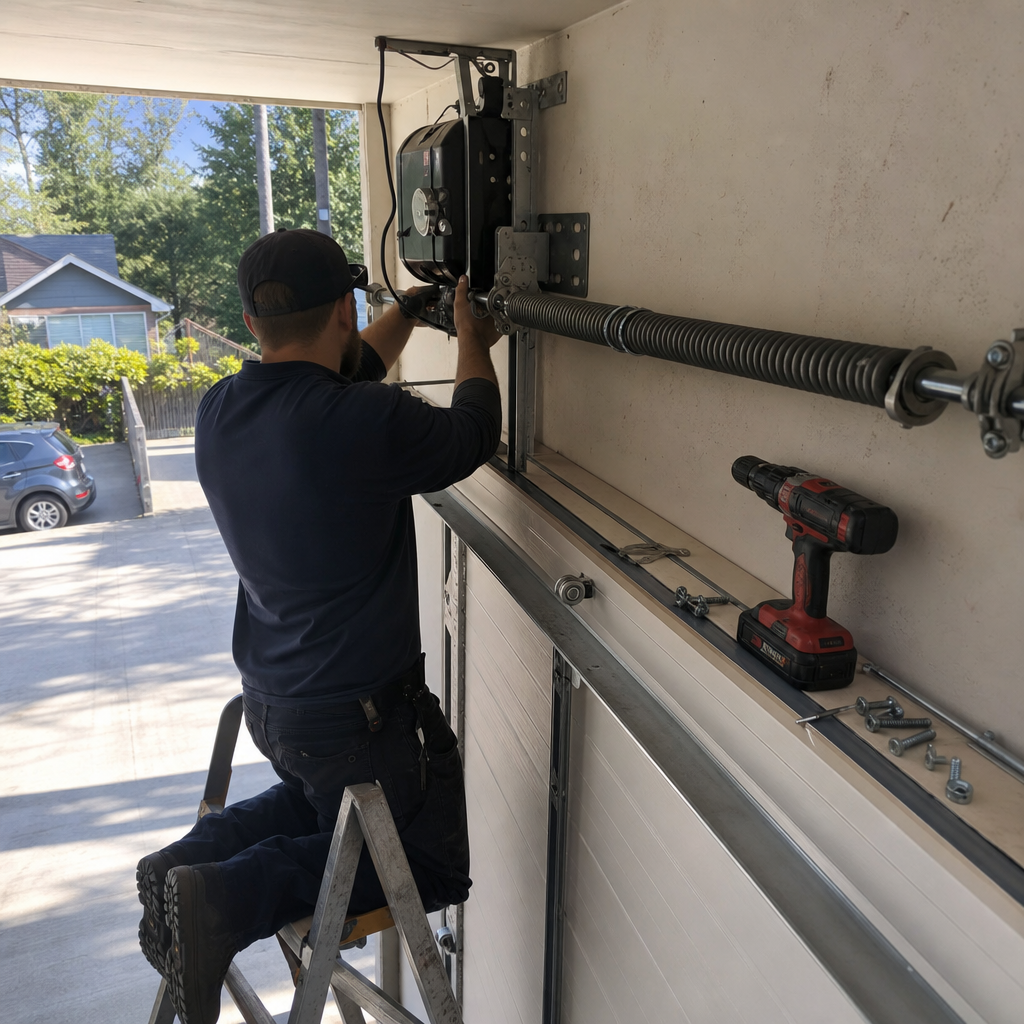
Washington’s housing stock tells its own story. Drive through neighborhoods like the older sections near Capitol Lake or the 1980s-era subdivisions off Harrison Avenue, and you’ll find attached garages with 7-foot ceilings, shallow depths, and torsion spring systems that haven’t been properly balanced since the original install. We’ve spent eight years on these doors. The opener isn’t the problem until it becomes the problem — usually because somebody skipped the compatibility step that matters most.
Why Drive Type Selection Depends on Your Actual Garage, Not a Feature Chart
Chain, belt, or screw drive — the decision starts with ceiling height and rail clearance, not noise level marketing. In Washington, homes built between 1975 and 1995 dominate the market, and their attached garages were designed for compact cars, not today’s SUVs with roof racks. That matters because:
- Chain drives need the most vertical rail clearance. Fine for 8-foot ceilings, but in a 7-foot garage with a low-profile door, the rail can sit dangerously close to vehicle height. We see this constantly in the Lakewood and Tumwater corridors.
- Belt drives run quieter and shave an inch or two off rail profile, which often makes the difference in older Washington homes where headroom is tight. The trade-off: slightly less brute torque tolerance for heavily insulated or oversized doors.
- Screw drives (Genie’s legacy format) occupy a middle ground on clearance but demand precise lubrication maintenance. Washington’s seasonal humidity swings — wet winters, dry summers — can accelerate wear if the homeowner skips the annual check.
Joseph Taylor personally measures door weight and spring torque before recommending any drive type. We’ve walked into jobs where a previous installer dropped a 3/4-horsepower Craftsman on a door that only needed 1/2-horsepower — and more critically, where the spring system was so far out of spec that the opener’s safety reverse triggered on every third cycle. That’s not a defective opener. That’s a mismatched system.
The Spring-Opener Torque Match: Why More Horsepower Doesn’t Fix a Bad Spring
Here’s the detail no product page explains: your opener doesn’t lift the door. The springs do. The opener provides controlled rotation and safety redundancy. When a spring is fatigued or improperly tensioned, the opener compensates by drawing more amperage, overheating its motor, and burning out the logic board — usually within 18 months of “installation.”
Our process on every Washington opener install:
- Weigh the door in its balanced position using a calibrated scale
- Measure spring wire gauge, coil count, and inside diameter
- Calculate actual torque requirement against door weight and track radius
- Specify opener horsepower and drive type from that data, not from a brochure
- Program force limits and safety sensitivity to the matched specification
A “more powerful” opener on weak springs just destroys itself faster. We’ve replaced Chamberlain units that failed at 14 months because the spring system was never addressed. The customer paid twice. We don’t do that here.
Brand-Specific Installation: What LiftMaster, Chamberlain, and Craftsman Actually Deliver
We’re factory-familiar with eight major brands, but four dominate our Washington opener installations. Here’s how we guide the choice based on real garage conditions, not marketing:
| Brand / Model | Best Fit For | Washington-Specific Consideration |
|---|---|---|
| LiftMaster 8500W (wall mount) | High-ceiling garages, commercial-grade cycling, or homeowners who need the rail entirely eliminated | Requires 12 inches of side clearance and solid header mounting. Excellent for detached workshops in the rural outskirts, but we verify wall structure before quoting — older Washington garages sometimes lack the stud backing. |
| LiftMaster WLED (belt drive) | Standard attached garages with moderate headroom | The LED lighting is genuinely useful in Washington’s dark winter mornings. We install more of these than any other unit in the Capitol Campus and South Capitol neighborhoods. |
| Chamberlain B6753T (MyQ ecosystem) | Tech-forward homeowners with reliable router placement | MyQ and similar smart systems require stable 2.4GHz signal at garage depth. In Washington homes with thick lathe-and-plaster exterior walls or detached garages set back from the house, we’ve mapped signal dead spots that make Wi-Fi-dependent features unreliable. We test this before recommending the smart upgrade. |
| Craftsman CMXEOCG (chain drive, value tier) | Rental properties, secondary garages, or budget-conscious replacement | Straightforward mechanical reliability without connectivity complexity. We pair these with proper spring service so they outlast their warranty period — which they won’t if the door system is ignored. |
Raynor and Wayne Dalton openers have their place in specific retrofit scenarios — particularly when we’re matching an existing rail system or warranty-claiming a failed unit. We work on your brand, whatever it is. But we won’t install a unit that the garage can’t support mechanically.
The Wi-Fi Reality Check: Smart Openers Need Signal, Not Just Features
Every month, a Washington homeowner calls us frustrated that their new “smart” opener won’t connect reliably. The opener isn’t defective. The garage is a Faraday cage.
Concrete foundations, metal siding, foil-faced insulation, and distance from the router combine to kill 2.4GHz penetration. In the hillside homes above Puget Sound exposure areas, or the detached garages common in the older Lacey subdivisions, we’ve seen signal strength drop below -70 dBm at the opener location — below functional threshold for MyQ, Aladdin Connect, or similar platforms.
Before we quote a smart opener, we ask: where’s your router, what’s between it and the garage, and do you already struggle with Wi-Fi out there? If the answer involves concrete walls or 40+ feet of distance, we discuss alternatives — wired wall button extensions, Z-Wave bridge solutions, or accepting a non-connected opener that actually works every time. Joseph Taylor’s the one who makes that call on site, not a dispatcher reading from a compatibility script.
Owner-Operator Accountability: The Same Person Installs It and Answers the Callback
Here’s a practical difference that matters after day one. When we install your opener, Joseph Taylor personally leads every job. If the safety sensors drift out of alignment three weeks later, or the force settings need seasonal adjustment, or you just want to understand why the light blinks twice — you’re talking to the same person who set the limits originally. Not a call center. Not a rotating subcontractor who wasn’t on the original install.
Nearly 600 customers have rated us 4.8 stars across eight years of focused garage door work. That volume and consistency signal something specific: we show up, we diagnose accurately, and we stand behind the configuration. If the door’s giving you trouble, there’s a reason — let’s find it and fix it right the first time.
Whether it’s a broken spring at 7 a.m. or a Garage Door Opener installation you’ve been planning for months, the same standard applies. We don’t hand off accountability.
What Washington Opener Installation Costs — And What’s Included
Our pricing is upfront and itemized. The table below reflects actual Washington market rates for professional installation with proper spring assessment and system matching:
| Service | Price Range |
|---|---|
| Garage Door Opener Installation (standard belt/chain, 1/2–3/4 HP) | $295–$650 |
| Opener Repair (diagnostic, gear replacement, limit adjustment, safety sensor alignment) | $140–$380 |
| Spring Repair (torsion or extension, including balance verification) | $210–$400 |
| Cable Repair (frayed or snapped cables, drum reset) | $155–$295 |
| Track Realignment (bent or shifted vertical/horizontal tracks) | $140–$285 |
| Roller Replacement (nylon or steel, full set) | $130–$260 |
| Panel Replacement (matching existing door section) | $295–$590 |
| New Door Installation (full system, door, hardware, opener optional) | $825–$2,595 |
| General Garage Door Repair (comprehensive diagnostic and repair) | $175–$710 |
The opener installation range assumes standard ceiling mount, existing electrical outlet within 6 feet, and a door system we’ve verified as properly balanced. If spring replacement or track modification is needed to achieve compatibility, we quote that separately before beginning work — no bundled mystery pricing.
FAQs
Professional garage door opener installation in Washington costs $295–$650 for a standard belt or chain drive unit, including removal of the old opener, rail assembly, safety sensor placement, and force-limit programming. Call (844) 749-2402 for an exact quote — estimates are free.
Opener repair ($140–$380) makes sense for units under 10 years old with isolated failures like stripped gears or misaligned sensors; replacement is the better investment when the motor is burning out, the rail is obsolete, or repair parts are discontinued for your model. We assess this honestly on every call — 8 years in the trade means we’ve seen which repairs stick and which become recurring money pits.
Same-day installation is available for most standard opener models when you call before noon, and emergency garage door service is built into our core offering for situations where the door is inoperable and your vehicle is trapped inside. We stock LiftMaster, Chamberlain, and Craftsman units for immediate deployment across Washington.
Smart openers rely on stable 2.4GHz signal at the garage location, and Washington’s older homes with thick exterior walls or detached garages often create signal dead zones that the opener can’t overcome — we test this during our pre-install assessment and recommend non-connected alternatives or signal extension solutions when smart features won’t perform reliably.
Ready for an Opener That Actually Matches Your Door?
Don’t pay for a motor that fights your springs every cycle. Call (844) 749-2402 now for a free estimate — we’ll weigh your door, assess your spring system, and recommend an opener configured to work with your garage, not against it. Same-day scheduling available, and Joseph Taylor personally leads every installation.
Written by Joseph Taylor, Owner & Lead Technician at Matrix Garage Door Repair Washington, serving Washington, WA.